

If you needed one sentence to summarize UXDX NYC, it would be this:
AI is an amplifier of whatever discipline you brought with you.
That thought ran through almost every talk, and it's the most honest framing I've heard for what's happening in our field right now. AI doesn't make a careless designer careful, or a sloppy team rigorous, it scales whatever you walked in with. If your inputs are thoughtful, the output will bend toward thoughtfulness. If your inputs are slop, you've already met the result… slop.
For UX designers, that framing is both reassuring and a little uncomfortable. Reassuring because craft still matters. Uncomfortable because there's nowhere left to hide.
The job is changing, even if our work isn't
Roles aren't staying still. Tasks are shifting. Workflows are getting shorter. Prototyping might even be happening in production. The cleanest framing I heard: AI ships outputs. You ship outcomes. AI can produce a screen, but it can't tell you whether that screen is solving the right problem for the right person. The bottleneck has moved from "can we build this?" to "should we, and is what we built actually any good?"
That second question is the designer's job. It has gotten louder.
Our edge is still what we know about the user
We know who the user is. We know what they got burned by, how the support tickets actually sound, the workaround they've been quietly using for years, and the job they're really trying to do. That context is invisible to an AI model.
So the question isn't "can AI do my job?" It's "how do I use AI in a way that adds my context, instead of substituting for it?" The working pattern that came up over and over was don't use AI as the starting point, use it as the refinement. Bring your notes, your sketches, your sense of the user, and let the tool sharpen and render.
The quieter risk is atrophy. If you only ever use AI as the starting point, you stop flexing and growing the muscles that made you valuable in the first place. The design craft still has to exist, or you have no judgment to check the AI with.
Where we can put intentional friction back in
The talks didn't say "slow down." They said "be deliberate about where you put the friction."
The line that stuck: hack it, but not into production. Build proximate, high-fidelity prototypes so stakeholders give you high-fidelity feedback. But also keep in mind that more rounds of user testing, more clarity about who the thing is for, and real IRL discovery will happen. Without that, teams will sprint off in the wrong direction with conviction. As Rory Madden, founder of UXDX, said “It’s never been easier to ship something confidently, that’s completely wrong.”
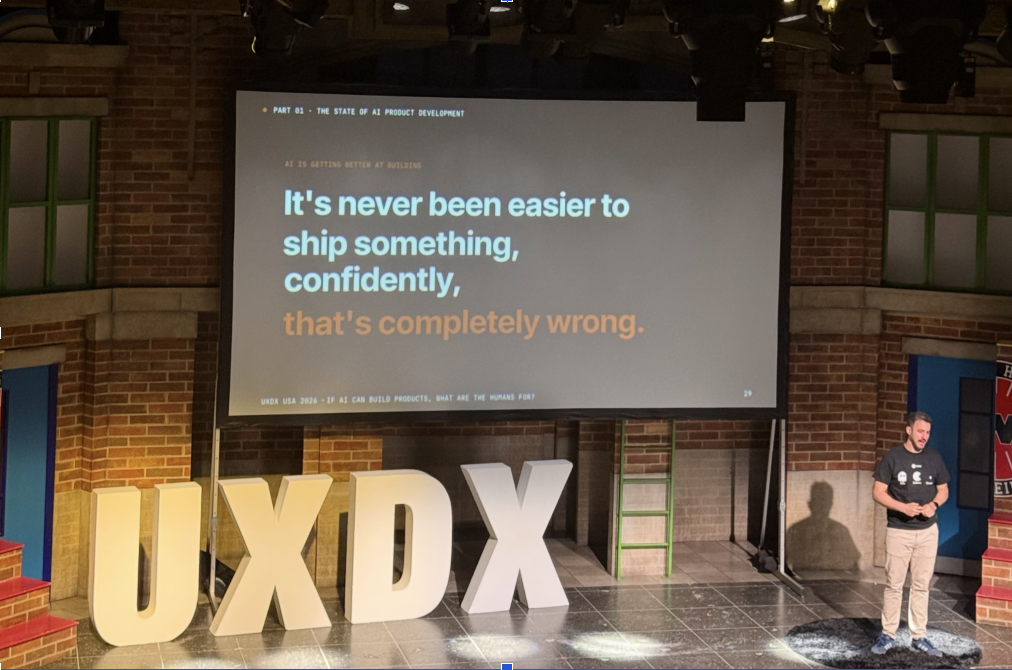
The slide that set the tone for the whole conference: confident shipping and good shipping are not the same thing
Efficiency or efficacy, that’s the question
The metaphor that stuck with me from the opening night was…
Is AI like the moving walkway at the airport?
Does it get you somewhere faster, or does it just substitute for walking?
There's a version of our jobs where AI helps us cover more ground without losing the steps. We move faster, explore more options, test with more users, ship better products. And there's a version where AI stands in for the work, the way the walkway stands in for the actual walking. You end up at the same gate, but you didn't really go anywhere.
Which version we end up in is on us. Bring your craft, your context, your judgment. Use the tools to amplify those things, not to replace them. The bottleneck has moved to checking the AI, to discovery, to clarity about who we're solving for.
A possible design renaissance
A hopeful idea kept surfacing as well, if everyone uses the same tools the same way, every product starts to look the same. The response, if we want it (🤞👀🤞), is a design renaissance. A return to authenticity, craft, and thoughtfulness in the practice of design.
AI slop becoming the default doesn't automatically make craft fashionable again, but it opens a door. Teams that lean into craft, authenticity, and the depth of knowledge they actually have will stand out, because so much else won't. Designers are the facilitators of the creative process, and that role only gets more valuable as the baseline gets more generic.
… so how do I sleep at night?
Knowing that AI doesn't replace the designer's job. It exposes which parts of it were always the job:
- Knowing the user, respecting the user, and advocating for them.
- Asking the right questions even if they're controversial.
- Checking the work at each stage, at the fidelity it calls for. Just like AI, we don't get it right the first time.
🔼✨ Looks a lot like the iterative design process ✨🔼
So, we as designers should continue to lean into those parts because the teams that do will keep building things worth shipping. The ones that don't will keep wondering why theirs feel like everyone else's 👀
Tune in next time for an engineer’s perspective…