
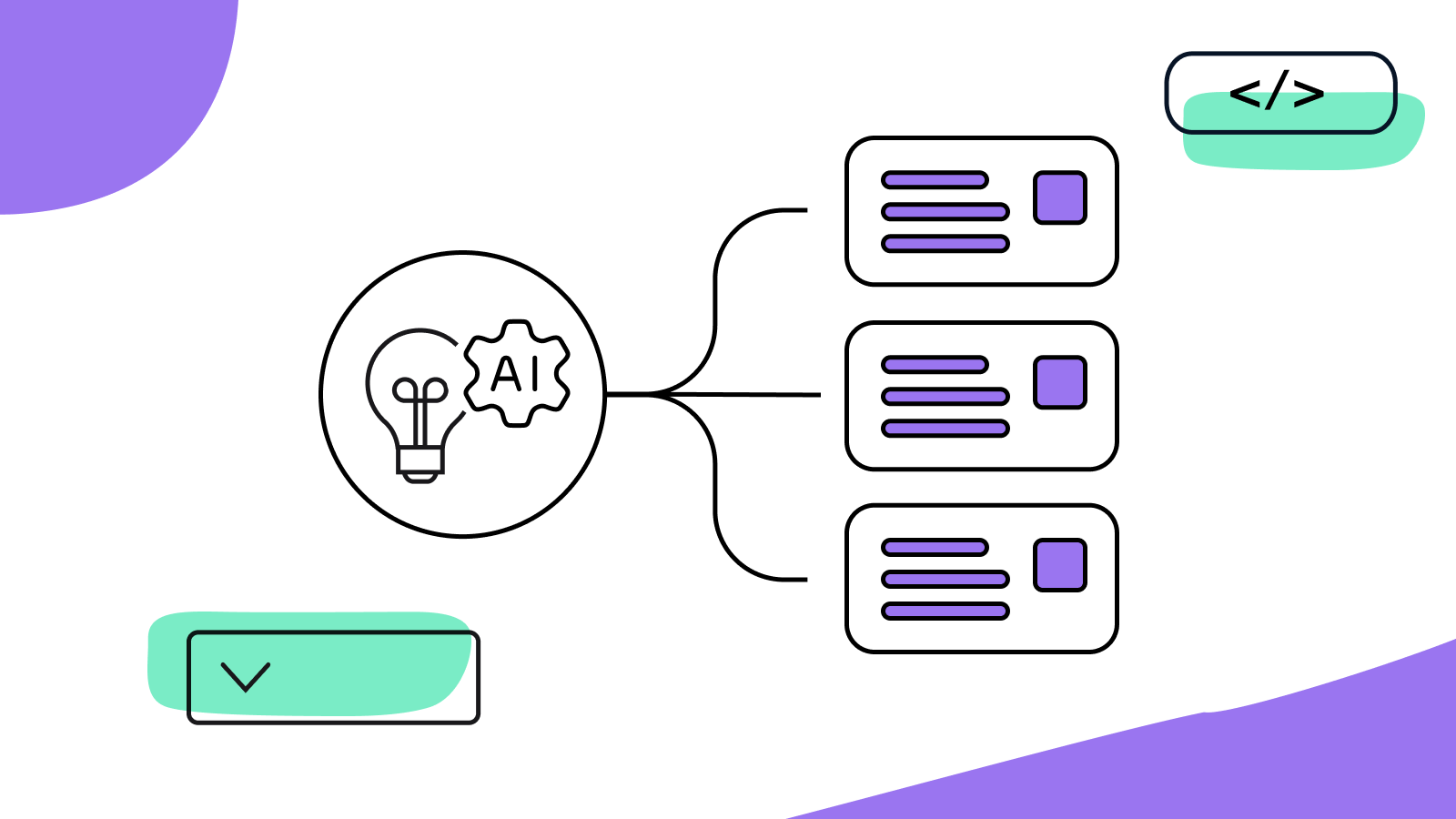
Explore real-world examples of how Knapsack’s MCP server connects AI initiatives to repeatable business processes—turning experiments into measurable business value.
Everywhere you look, teams are experimenting with AI. Demos are impressive, pilots are flashy—and then… they go nowhere.
Most AI projects stall because they’re not connected to real, repeatable business processes—and never create measurable value.
Knapsack changes that.
Our MCP server operationalizes your design system so AI agents, workflows, and teams can query, compare, generate, and ship production-ready digital products—efficiently, consistently, and securely at scale.
The result is simple but transformative: AI that works the way your business does.
Below are real-world use cases showing how teams are using Knapsack to turn AI into an engine—driving innovation, efficiency, and measurable ROI.
AI-Powered Prototyping — Experiments That Actually Ship
Even the best design systems can’t anticipate every new feature or product demand. Teams need ways to explore and validate ideas fast—without wasting cycles on throwaway prototypes.
With Knapsack’s MCP server, teams use AI to generate prototypes based on existing code directly from trusted system sources. Every experiment starts grounded in the same components, tokens, and standards used in production.
Example:
Rowan, a UX researcher, needs prototypes for an accessibility study on a new product feature. Instead of rebuilding mockups from scratch in a design tool, they prompt an AI agent connected to Knapsack’s MCP server to generate interactive, standards-compliant prototypes instantly. From there, Rowan can explore additional scenarios:
- Rapid Prototyping → Spin up additional prototypes in real time for research sessions and user testing.
- Framework Migration → Generate components in new frameworks (React, Handlebars, SwiftUI) to validate migration paths.
- Proof of Concept → Create quick demos that pull from both internal systems and open-source libraries.
- Feature Planning → Identify system gaps and generate suggested components for review.
The result: Prototypes become part of the delivery pipeline instead of throwaway work. Teams accelerate research and validation, reduce rework, and ship ideas that are production-ready from day one.
AI Audits That Create Consistency Without the Cost
Keeping design systems and live products aligned and compliant is tough. Drift creeps in, legacy features fall behind, and compliance risks pile up. Manual audits are slow, expensive, and out of date before they’re finished.
With Knapsack’s MCP server, teams use AI to run real-time gap analysis across design systems, product code, and documentation. Instead of weeks of manual work, a single person can surface inconsistencies, benchmark system health, and automate recurring compliance checks.
Example:
Casey, a product manager for their company’s design system, uses Knapsack’s MCP server to analyze design sources, product code, and documentation. With a connected AI agent, Casey can audit the system from multiple angles:
- Health Audits → Catch drift between design tokens and production code.
- Consistency Checks → Compare products across platforms to find mismatched components.
- Legacy Reviews → Audit older apps and features against current standards to uncover modernization opportunities.
- Compliance Automation → Flag accessibility and regulatory issues before they create risk.
The result: Audits that once took weeks now take minutes. Teams maintain alignment across design and code, reduce compliance costs, and continuously modernize their product ecosystem without breaking delivery momentum.
AI Onboarding Enables Day-One Productivity
Onboarding new team members is a constant challenge. Designers, engineers, and product managers need fast access to standards, examples, and documentation—but that information is often scattered across tools and wikis. The result is slow ramp-up, inconsistent work, and a lot of avoidable questions.
With Knapsack’s MCP server, onboarding becomes AI-assisted and system-aligned. New contributors can query the design system, codebase, and documentation directly—getting trusted, production-ready answers from day one.
Example:
Priya, a new front-end engineer, has been asked to build a settings panel for a mobile app. Normally, she’d spend days digging through GitHub repos and Confluence pages to find examples of components, then ask teammates to confirm whether she’s using the right tokens or layouts. Instead, she uses an AI agent connected to Knapsack’s MCP server to find approved components, tokens, and layout patterns instantly. Within minutes, she’s able to:
- Component Usage → Pull existing, production-ready components.
- Documentation Access → Query live, up-to-date system docs and design tokens.
- Role-Based Training → Generate walkthroughs tailored to her specific role.
- Accessible Prototypes → Create test-ready prototypes aligned to system standards.
The result: New contributors are productive from their first sprint, teams stay consistent across disciplines, and knowledge transfer becomes a built-in part of delivery.
AI-Driven Delivery That Keeps Launches on Track
Coordinating product launches across multiple platforms and teams is always a race against the clock. Product managers need consistency across web and mobile, while marketing teams scramble to align campaigns and creative. Miscommunication leads to missed deadlines, inconsistent experiences, and last-minute fixes that erode quality.
With Knapsack’s MCP server, product and marketing teams use AI to generate production-ready code and brand-aligned content from the same trusted design system.
Example:
Amina, a product manager, is preparing to launch a new feature across web and mobile. She’s working with Alex, a marketing lead, to ensure the campaign goes live the same day. Normally, this would mean weeks of work, followed by last-minute marketing revisions to match the UI. Deadlines are tight, and launches often slip.
This time, Amina uses Knapsack’s MCP server to:
- Cross-Platform Delivery → Build consistent UI components for web and mobile from one design system.
- Framework Expansion → Extend reach by generating new components in alternate frameworks without rebuilding.
Meanwhile, Alex uses the MCP server to:
- Brand-Aligned Content → Generate marketing assets that match system standards and brand voice.
- Campaign Launch Assets → Produce compliant landing pages, emails, and microsites ready for third-party tools.
- Unified Execution → Keep campaigns and product UIs aligned for a seamless launch.
The result: Product and marketing move in lockstep—delivering unified, on-brand experiences across every channel while hitting their launch dates with confidence.
Knapsack’s MCP Server: The Infrastructure Behind AI That Works
Successful AI initiatives connect to real, repeatable business processes. They’re built on trusted infrastructure that turns creativity into consistent, scalable outcomes.
Knapsack’s MCP server operationalizes your design system so AI can move from isolated experiments to integrated delivery—building, auditing, onboarding, and launching with speed, security, and confidence.
The use cases above show how the MCP server transforms AI from a demo tool into a true production engine, bridging the gap between design, code, and content so teams can deliver meaningful value.
The result is simple but transformative: AI that works the way your business does.
See how Knapsack streamlines product creation – book a live demo.
